Your USP Is a Starting Point — Not the Whole Message
Last week, we talked about building a strong Unique Selling Proposition.
A good USP helps answer some very important questions:
What do you provide?
Who do you provide it to?
What problem do you help solve?
What makes your approach different?
Why does that difference matter?
That gives you a strong foundation.
But one statement cannot do every job.
Your website needs more than a USP.
Your Google Business Profile needs a concise business description.
A networking conversation needs something short and natural.
A proposal may need to explain your process and reinforce your value.
A sales conversation may need to address hesitation or objections.
A social media post may focus on one problem, benefit, or differentiator at a time.
The wording changes depending on the situation.
The message should not.
That is where a messaging system becomes important.
Stop Starting From Scratch
Think about how often you have to explain your business.
You may need to write:
- A website page
- A Google Business Profile description
- A social media bio
- A Facebook post
- An email introduction
- A proposal
- A brochure
- A presentation
- A networking introduction
- A service description
If every one of those starts with a blank screen, you are doing more work than you need to.
And when each piece is written at a different time, by a different person, or for a different purpose, the message can start drifting.
One piece emphasizes experience.
Another emphasizes price.
Another talks mostly about customer service.
Another describes the process.
None of those things may be wrong.
But taken together, they may not give customers a clear picture of why they should choose you.
A strong messaging system gives you the building blocks first.
Then you adapt them to the application.
Start With Your Core Message
Your core message is the central idea you want customers to understand about your business.
It should answer questions such as:
- Who do you help?
- What do you help them with?
- What makes your approach valuable?
- What do you want to be known for?
This is not necessarily one polished sentence.
Think of it as the anchor for everything else.
If someone reads your website, visits your Google profile, talks with you at a networking event, and sees your social media, they should come away with a similar understanding of your business.
Know Your Differentiators
Most businesses have things they do differently.
The problem is that those differences are often either undefined or described in ways that do not mean much to the customer.
- Experienced.
- Personalized.
- High quality.
- Great service.
Those may all be true.
But they are not particularly useful unless you explain what they mean.
A stronger differentiator connects the difference to the customer.
Instead of: We provide personalized service.
Try: You work directly with the same person throughout the process, so you are not repeatedly explaining your situation to someone new.
Now the difference means something.
Identify the Messages You Need to Repeat
Strong businesses usually have several important ideas they want customers to understand.
These might include:
- The problem you solve
- The result you help create
- Your approach or process
- Your strongest differentiators
- The experience customers can expect
- The reasons customers trust you
- The objections or concerns you commonly hear
These recurring ideas become your messaging pillars.
They give you a set of themes to return to again and again.
That is especially helpful for content.
Instead of constantly asking, “What should we post about?” you already know the topics that reinforce your value.
Give Customers Reasons to Believe You
It is one thing to say you are good at something.
It is another to prove it.
Your messaging should include proof points where appropriate.
- Years of experience
- Certifications
- Customer reviews
- Project results
- Case studies
- Awards
- Guarantees
- Specific processes
- Measurable outcomes
- Testimonials
Proof strengthens the claims you are making.
If your message says you are reliable, show what reliability looks like.
If you say your process reduces surprises, explain how.
If you say customers save time, show where that happens.
Address the Questions That Get in the Way
Good messaging also anticipates hesitation.
What questions do customers repeatedly ask before they buy?
- How much will this cost?
- How long will it take?
- Is this right for my situation?
- What happens if something goes wrong?
- Why does this cost more than another option?
- What exactly am I paying for?
Those questions should not be treated as interruptions.
They are clues.
If customers regularly hesitate over the same issue, your messaging should help address it.
Tell People What to Do Next
Clear messaging also includes a clear next step.
What do you want the customer to do?
- Call?
- Schedule a consultation?
- Request information?
- Visit the store?
- Download a resource?
- Send an email?
A vague message often leads to a vague response.
A clear call to action makes the next step easier.
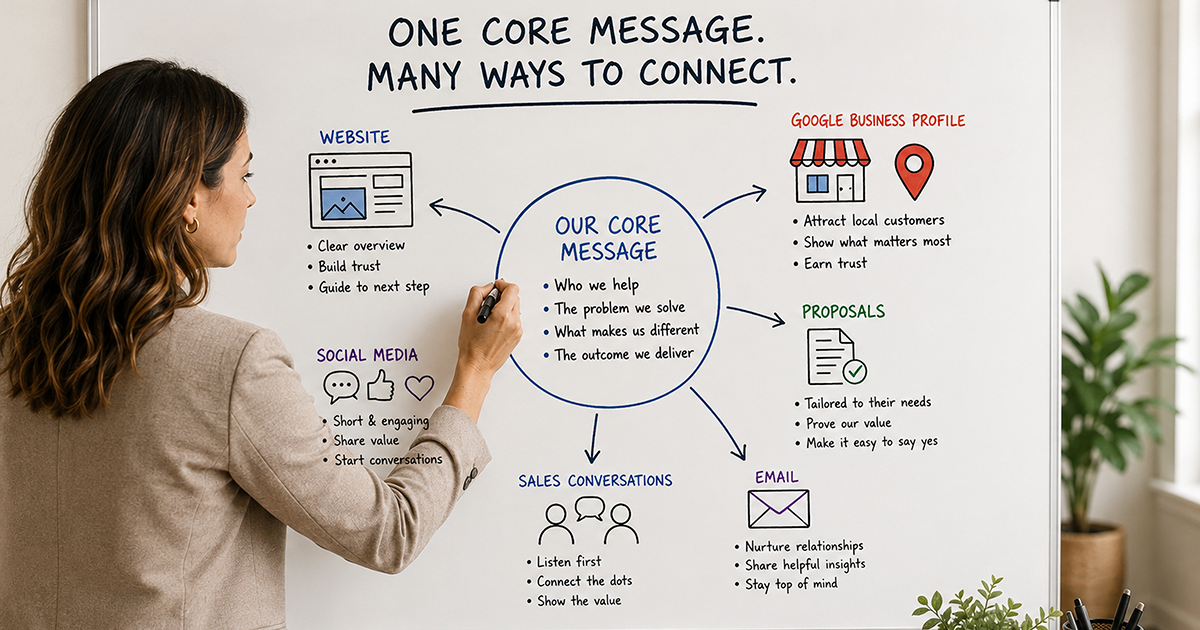
One Message, Many Applications
Once your messaging pieces are defined, you can adapt them.
Your networking introduction might use your USP and one differentiator.
Your homepage may use the core message, customer problem, benefits, proof, and CTA.
Your Google Business Profile may use a shortened version of the core message and differentiators.
A social post may focus on a single customer problem.
A proposal may lean more heavily on proof and objections.
The language changes. The underlying message stays connected.
That is the goal.
Consistency Does Not Mean Repetition
You do not need to say the same sentence everywhere.
In fact, you probably should not.
Messaging consistency means the ideas are aligned.
Customers should not encounter one version of your business on your website, another on Google, and a third when they talk to someone on your team.
Your brand should sound like the same business wherever people encounter it.
Make the Message Easier to Use
A good messaging system should make communication easier, not more complicated.
It gives you:
- A clear core message
- Defined differentiators
- Key benefits
- Messaging themes
- Proof points
- Objection responses
- Calls to action
- Short and long descriptions
- Language that can be adapted across different applications
Then you stop reinventing the message every time you need to create something.
You start building from something you already know is clear.
The Bottom Line
Your USP is an important first step.
But it is only one part of the message your business needs.
A strong messaging system takes the ideas behind your USP and turns them into practical language you can use throughout the business.
Because the goal is not simply to know what makes you different. The goal is to communicate it clearly and consistently wherever your customers encounter you.
Need Help Building the Message Around Your USP?
My Business Messaging Toolkit and Product/Service Messaging Toolkits help turn what makes your business valuable into clear, consistent language you can use across your website, Google presence, social media, sales conversations, proposals, and more.
Send me an email (laura@marketingblueprintsforsmallbiz.com) and let’s talk about what you need.