Why Should a Customer Choose You?
Most small businesses are pretty good at explaining what they do.
They can list their services.
They can tell you what they sell.
They can describe their experience.
They can explain how long they have been in business.
But when you ask: “Why should a customer choose you?”
the answer often gets much harder.
That is where your Unique Selling Proposition — or USP — comes in.
A USP is not a catchy slogan.
It is not a tagline.
And it is not a long list of everything your business does.
A strong USP helps a prospect quickly understand:
- What you provide
- Who you provide it to
- What problem you help solve
- How your approach is different
- Why that difference matters to them
In other words, it moves the conversation from what you do to why someone should care.
Start With What You Provide
This sounds like the easy part.
What product or service do you actually provide?
But try to be specific.
“Bookkeeping” is broad.
“Home remodeling” is broad.
“IT support” is broad.
The clearer you are about what you actually help people with, the easier it becomes to build the rest of the message.
You do not have to list every service you offer.
Start with the core thing you want to be known for.
Who Is It For?
This is where many businesses get vague.
“Anyone who needs our service” is not an ideal customer.
Neither is “small businesses,” “homeowners,” or “women over 40” by itself.
You do not need a 10-page customer profile to get started.
But you do need enough clarity to know who you most want to attract.
- New homeowners?
- Established small-business owners?
- Parents with growing families?
- Professionals who value convenience?
- Businesses that have outgrown a do-it-yourself solution?
The more clearly you understand who the offer is for, the easier it becomes to make your message feel relevant.
What Problem Are You Helping Them Solve?
People usually do not buy simply because a business offers a service.
They buy because something needs to change.
They have a problem.
A frustration.
A need.
A goal.
A gap between where they are and where they want to be.
A remodeler may provide construction services.
But the homeowner may really be trying to create enough room for a growing family.
A bookkeeper may provide monthly bookkeeping services.
But the business owner may really want confidence that the numbers are accurate and their finances are under control.
An IT company may provide managed support.
But the customer may really want fewer disruptions and confidence that someone will be there when technology goes wrong.
The service matters.
But the reason the customer cares about the service matters even more.
What Makes Your Approach Different?
This is often the hardest part.
Businesses fall back on phrases such as:
- Great customer service
- High quality
- Experienced team
- Competitive prices
- We care about our customers
Those things may all be true.
But they are also things almost every competitor can say.
Your USP needs to go further.
Ask:
- Do you have a different process?
- Do you specialize in a particular kind of customer or problem?
- Do you offer more flexibility?
- Do you provide a level of expertise others do not?
- Do you make the process easier?
- Do you reduce risk?
- Do you give the customer more control?
- Do you solve the problem in a different way?
The goal is not to invent something dramatic.
It is to identify what is genuinely different — and useful.
Why Does That Difference Matter?
This is the piece businesses often leave out.
A differentiator only becomes meaningful when the customer understands the benefit.
For example:
“We have been in business for 30 years.”
That is a fact.
But why should the customer care?
“Our 30 years of experience helps us identify potential problems before they become expensive surprises.”
Now the experience means something.
You have connected the business strength to something the customer values.
That is what turns a feature into a useful selling point.
Put the Pieces Together
A practical USP should answer a few basic questions:
We: Who are you?
Provide: What do you provide?
To: Who do you provide it to?
Who: What problem, frustration, or need are they dealing with?
By: How do you solve it differently or better?
That framework does not require fancy language.
In fact, your USP should sound conversational.
You should be able to say it out loud without feeling like you are reading advertising copy.
And it should be relatively short — ideally a few sentences, not a paragraph-long company history.
Put Your USP to Work
Once you have a clear USP, do not let it sit in a worksheet or disappear into a folder.
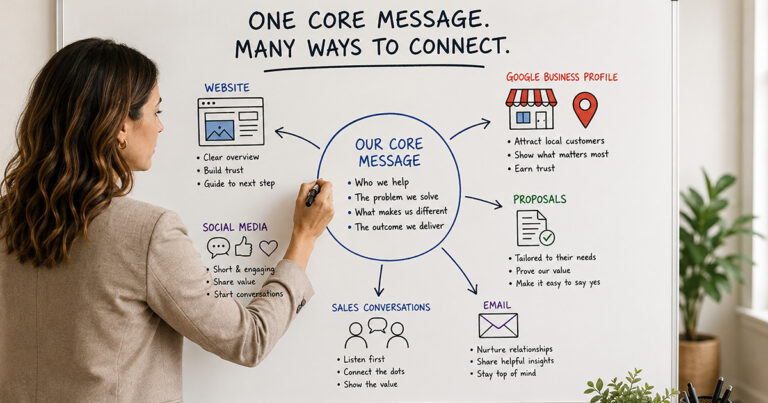
Use it as the foundation for the places where people need to quickly understand what you do, who you help, and why your business may be the right choice.
That might include:
- Networking events — as the basis for how you answer, “What do you do?”
- Your website — especially your homepage and key service pages
- Google Business Profile — to strengthen your business description, services, products, and updates
- Social media profiles — so your bio or About section quickly communicates who you help and why
- Sales conversations — so you and your team have a consistent way to explain the business
- Proposals and presentations — to reinforce why your approach is a good fit
- Email introductions and referrals — to give people a clear, concise way to understand your value
- Printed collateral — including brochures, one-sheets, and trade-show materials
You do not need to copy and paste the exact same three-to-five-sentence USP everywhere.
Think of your USP as source material. The core idea stays the same, but you adapt it to the situation.
At a networking event, it may become a 20-second introduction. On Google, it may shape your business description. On your website, it may influence your headline, supporting copy, and differentiators.
That is one of the reasons a clear USP is so useful: it gives you a consistent starting point wherever your business needs to explain its value.
A USP Is Not the Final Message
Your USP is an important building block.
It gives you a clearer way to explain what makes your business relevant and different.
From there, you can build stronger website copy, social content, sales messages, service descriptions, and other customer-facing communication.
We will go deeper into that next week.
But first, you need the foundation.
Because if you cannot clearly answer “Why should a customer choose you?” it becomes very difficult to expect your communication to answer it for them.
One Simple Test
Read your USP and ask: Could one of my competitors say exactly the same thing?
If the answer is yes, it probably is not finished yet.
A strong USP does not have to sound clever.
It needs to sound clear, relevant, and specific enough that the right customer understands why your business deserves consideration.
And that is a much better starting point.