Your Website Is the Structure That Supports the Rest of Your Marketing
There are a lot of ways someone may first encounter your business.
They may see a Facebook post.
Find you on Google.
Read something on LinkedIn.
Open an email.
Click an ad.
Hear your name from someone they trust.
Meet you at a networking event.
Pick up a brochure.
All of those things can help create awareness.
But what happens next?
Where do people go when they want to learn more?
That is where your website becomes so important.
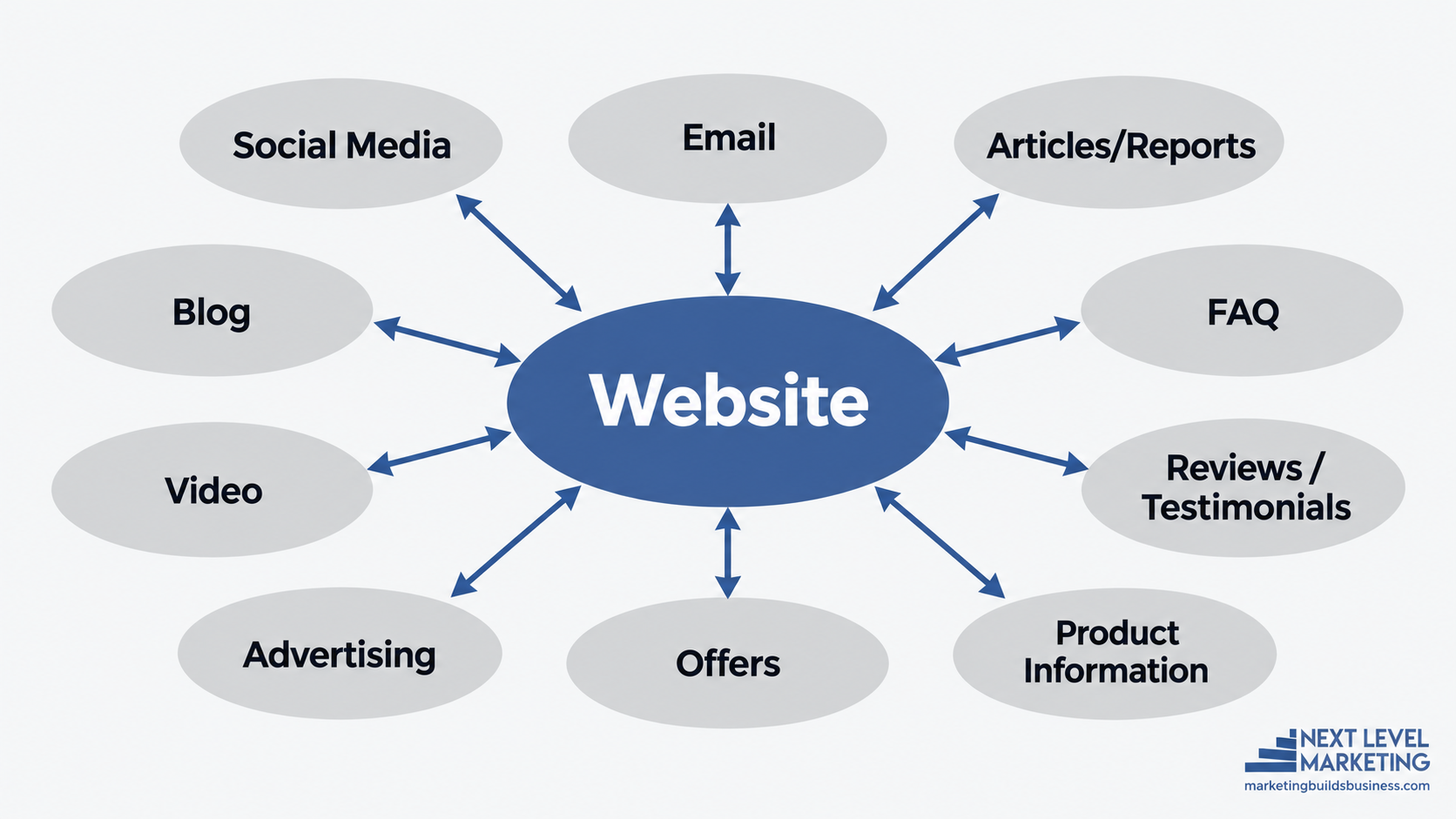
Social media, email, Google, advertising, referrals, and other tactics can help guide people toward your business. Your website gives them a solid place to land.
Your Website Should Support the Rest of the Structure
Think about a building.
Individual pieces can be well made, but they work best when they are connected to a larger structure.
Marketing works the same way.
A social media post can generate interest.
An email can share useful information.
Google can help someone discover you.
A referral can create trust.
An advertisement can get attention.
But the website gives those efforts somewhere to connect.
It is where the customer can move from simply noticing your business to actually understanding it.
Your Website Is a Place You Control
You do not control Facebook.
You do not control LinkedIn.
You do not control Google.
Algorithms change.
Platforms change.
Reach changes.
Rules change.
Your website is different.
It is an asset you control.
You decide:
- What information lives there
- How your business is presented
- What message visitors see
- What content is available
- What products or services are highlighted
- What proof you provide
- What you want someone to do next
That makes the website fundamentally different from many of the channels you use to promote the business.
Give Your Content a Permanent Home
Businesses create a lot of useful content.
Blog posts.
Articles.
Videos.
FAQs.
Project examples.
Customer stories.
Testimonials.
Guides.
Service information.
Educational resources.
If those things live only on social media, they can disappear quickly.
A Facebook post moves down the feed.
A LinkedIn post gets buried.
An email gets opened and forgotten.
But when your best information also lives on the website, it becomes part of something larger.
It continues working.
It gives prospects something to explore.
And it gives the rest of your marketing something useful to point toward.
Create Once. Use It in More Than One Place.
A strong website also makes your marketing more efficient.
You do not have to invent an entirely new idea for every channel.
A blog post on your website can become:
- A Facebook post
- A LinkedIn article or post
- An email
- A Google update
- A short video
- A sales follow-up resource
- A conversation starter
The website gives the full idea a permanent place to live.
The other channels help distribute it.
That is a much stronger system than creating isolated pieces that have no connection to one another.
Your Website Should Bring the Foundation Together
We have spent the past several weeks working through important parts of the marketing foundation:
- Visual brand
- Brand standards
- USP
- Differentiators
- Core messaging
- Ideal customer
The website is one of the first places where all of those elements have to work together.
The site should look like your business.
It should sound like your business.
It should speak to the customer you actually want.
It should reflect what makes you different.
It should make your products or services easy to understand.
And it should help people know where to go next.
A Website Should Not Be a Digital Filing Cabinet
There is a difference between giving people useful information and simply putting everything you have online.
Your website should be organized around what the customer needs.
Not around your internal filing system.
Visitors should not have to hunt through pages trying to figure out:
What do you do?
Is this for me?
Why should I choose you?
Where do I find more information?
How do I contact you?
A strong structure helps answer those questions quickly.
It Should Support the Customer Journey
Someone may not be ready to call you the first time they visit.
They may simply be checking you out.
They may be comparing options.
They may want to see examples.
They may need more information.
They may want to understand your process.
A useful website gives them room to do that.
It helps them take the next step in their own decision-making process.
Sometimes that next step is contacting you.
Sometimes it is reading another article.
Sometimes it is reviewing a service page.
Sometimes it is signing up for something.
The key is that the website keeps the relationship moving forward.
The Rest of Your Marketing Should Support the Website Too
This relationship works both ways.
Your website supports your marketing.
And your marketing should support the website.
If you publish a useful article, share it.
If you create a strong resource, promote it.
If you add a new service page, drive people to it.
If you publish a case study, use it in sales conversations and email.
The pieces become more valuable when they reinforce one another.
The Bottom Line
Your website should not be sitting off to the side while the rest of your marketing happens somewhere else.
It should be part of the structure that supports all of it.
It gives your content a place to live.
It gives prospects a place to learn.
It gives your brand and message somewhere to come together.
And it gives all of the other marketing you are doing a solid place to send people.
Because the goal is not just to get attention.
It is to give that attention somewhere useful to land.