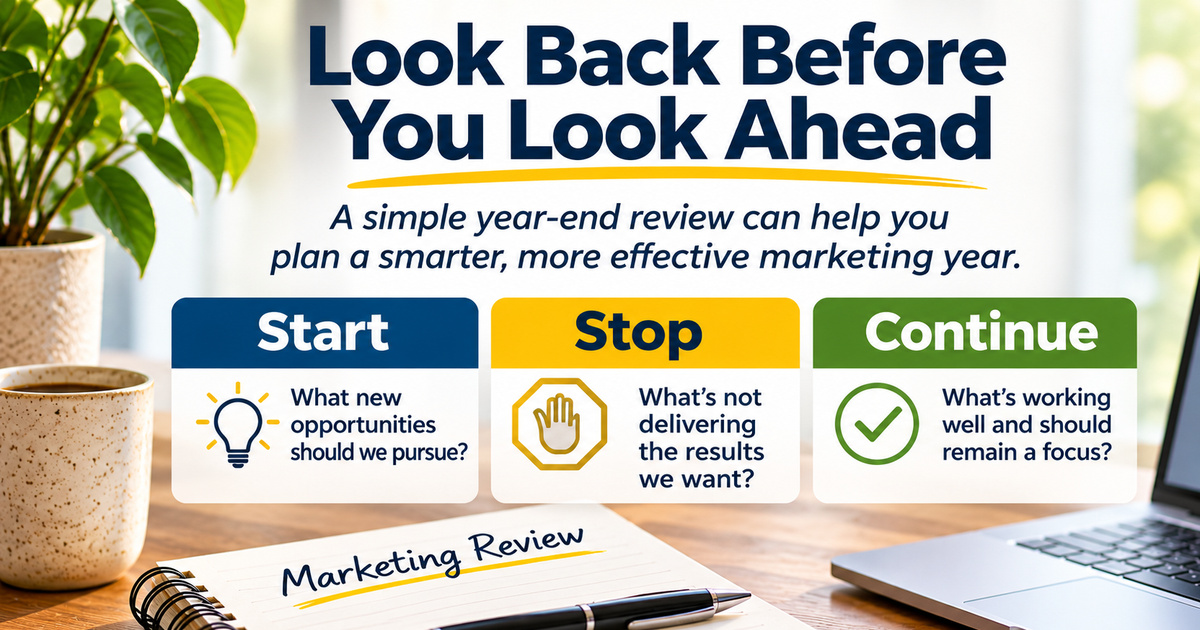
Before You Plan Next Year’s Marketing, Take a Look Back
What this year’s marketing can teach you about making better decisions next year.
As the year winds down, it’s tempting to start thinking about everything you want to do differently next year.
Maybe you’ve been considering a new website, a bigger social media presence, more advertising, or finally getting serious about email marketing.
But before you start adding new activities to your marketing calendar, there’s something important you need to do.
Take an honest look at the marketing you’ve already been doing.
You don’t need an elaborate analysis or a stack of reports. You simply need to understand where you’ve invested your time and money, what you’ve accomplished, and what you’ve learned along the way.
Here’s where to start.
1. Take Inventory of Your Marketing Activities
Begin by listing the ways you’ve marketed your business over the past year.
Think beyond advertising and social media. Your marketing activities might include:
- Your website and Google Business Profile
- Social media posts and engagement
- Paid advertising, online or traditional
- Email newsletters and customer communications
- Networking events and referral relationships
- Trade shows, sponsorships, or community involvement
- Printed materials, direct mail, or promotional products
You may be surprised by how many different things you’ve been doing.
And that’s part of the point.
When marketing activities accumulate without an overall plan, it’s easy to spread your time and resources across too many things without knowing which ones deserve your attention.
2. Look at What Actually Worked
Now comes the more important question: What results did those activities produce?
Did your website generate inquiries? Did advertising bring in qualified prospects? Did networking create valuable referral relationships? Did your email communications help bring customers back?
Whenever possible, look at actual numbers rather than relying on impressions.
Website traffic, inquiry volume, qualified leads, appointments, sales, and repeat business can all provide useful information.
But don’t assume that every marketing activity should be measured the same way.
A networking relationship may take months to produce a referral. Social media may be helping prospects feel more confident about choosing your company, even when it doesn’t generate immediate inquiries. A Google Business Profile may influence customers who contact you without ever visiting your website.
The real question is whether each activity is accomplishing what you intended it to accomplish.
And if you never established that purpose in the first place, you’ve just identified something to address in next year’s marketing plan.
3. Identify What Didn’t Work — and Why
Not every marketing effort will deliver the results you expect.
That doesn’t necessarily mean the tactic itself was a bad choice.
An advertising campaign might have reached the wrong audience. A social media effort may have lacked consistency. A website might attract visitors but fail to give them a compelling reason to contact you.
Sometimes the problem isn’t the marketing activity. It’s the messaging, execution, or lack of a clear strategy behind it.
Before abandoning something, ask yourself:
- Was this activity appropriate for the audience I wanted to reach?
- Did I have a specific goal for it?
- Was my message clear and compelling?
- Did I give it enough time and resources to work?
- Was there an effective way for interested prospects to take the next step?
These questions help you distinguish between an ineffective tactic and an ineffective approach to using that tactic.
That distinction can save you considerable time and money.
4. Decide What to Continue, Improve, or Stop
Once you’ve reviewed your activities and results, start sorting them into three categories.
Continue: Activities that are producing worthwhile results and supporting your business objectives.
Improve: Activities that have potential but need better messaging, execution, consistency, or follow-up.
Stop: Activities that no longer make sense for your business or aren’t worth the resources they require.
This is also a good time to identify unfinished marketing projects.
Maybe your website needs updates, your Google Business Profile is incomplete, or you started developing a customer email list but never implemented a communication plan.
Not every unfinished project needs to carry into the new year. Decide which ones deserve attention and which ones can be set aside.
Remember, the objective isn’t necessarily to do more marketing.
It’s to make better use of the marketing resources you already have.
5. Use What You’ve Learned to Look Ahead
Your year-end review isn’t the marketing plan itself. It’s the information that helps you create a better one.
Once you understand what’s working, what isn’t, and where opportunities exist, you can begin setting meaningful goals for the coming year.
Those goals should reflect what your business needs to accomplish — whether that’s attracting more qualified prospects, growing a particular service line, increasing repeat business, or improving customer retention.
From there, you can develop marketing strategies and select the activities most likely to help achieve those goals.
That process is far more effective than simply deciding to post more often, spend more on advertising, or try whatever marketing tactic happens to be popular.
The Bottom Line
You don’t have to solve every marketing problem before the calendar turns.
But you should have a reasonably clear understanding of what you’re carrying forward.
What deserves more attention? What needs to change? What can you leave behind?
And perhaps most importantly, do you have the planning, foundation, and messaging in place to make your marketing more effective?
Before you start building next year’s marketing calendar, take time to answer those questions.
Because the best place to start planning where you’re going is understanding where you’ve been.